Montgomery County Ohio Property Reappraisal 2026: What Homeowners Need to Know”
What Is the 2026 Montgomery County Ohio Property Reappraisal?
Montgomery County property values increased an average of about 19% with the 2026 property reappraisal, but that does not mean property taxes will increase 19%. According to Montgomery County Auditor Karl Keith, the 19% average increase in property values equates to approximately a 1.5% to 2% average increase in property taxes. It is not a one-for-one increase. 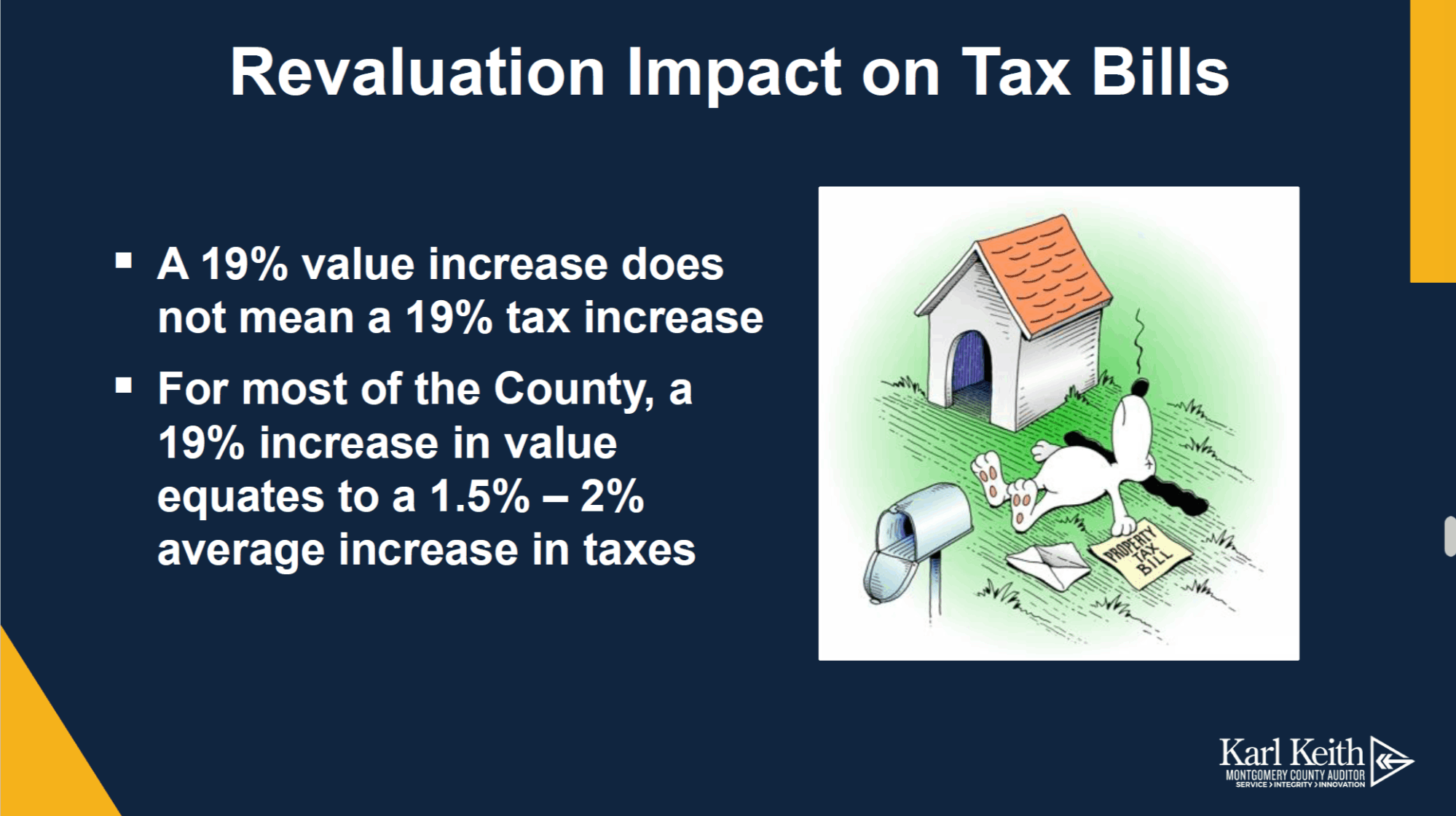
I've been selling real estate in the Dayton area for more than 30 years, and property reappraisals almost always generate questions and concern from homeowners. When someone sees that the county has increased the value of their home substantially, their first reaction is often, "Does this mean my taxes are going up by the same percentage?"
The answer is no.
The new 2026 values will take effect in 2027 and will affect property tax bills paid in 2027.
Is 2026 a Reappraisal or a Triennial Update in Montgomery County?
This is one of the most misunderstood parts of Ohio property valuation.
2026 is a full property reappraisal in Montgomery County, Ohio. It is not the triennial update.
Ohio counties operate on a six-year reappraisal cycle, with a triennial update occurring halfway through that cycle. Not all counties in Ohio are on the same schedule. Montgomery and Greene counties happen to be on the same schedule.
For Montgomery County:
- 2020 was a full reappraisal.
- 2023 was the triennial update.
- 2026 is a full reappraisal.
- 2029 will be the next triennial update.
- 2032 will be the next full reappraisal.
I've found that homeowners often use the terms "reappraisal," "revaluation" and "update" interchangeably, but there is an important difference between the two processes.
What Is the Difference Between a Reappraisal and a Triennial Update?
A full reappraisal is much more comprehensive.
During a full reappraisal, properties are reviewed individually. The Montgomery County Auditor considers individual property characteristics such as the home's style, grade and condition, along with recent valid sales in the neighborhood.
A triennial update is different.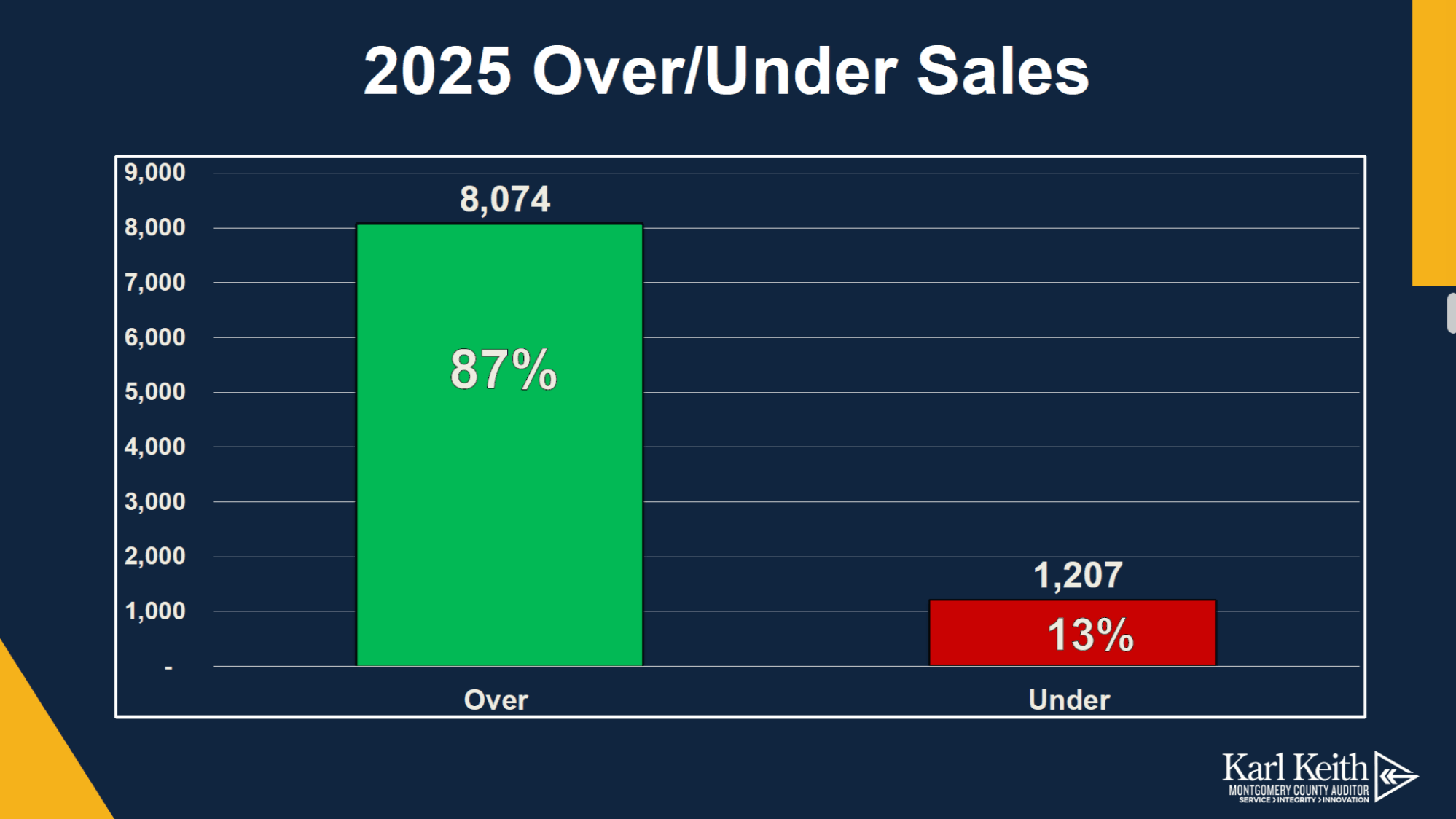
The triennial update occurs three years after the full reappraisal and relies much more heavily on general real estate sales and market trends within individual neighborhoods. Instead of conducting another complete reappraisal, values are statistically adjusted to reflect changes in the general real estate market.
That's why I think it's important for Montgomery County homeowners to understand which process is taking place. The 2026 valuation is the more comprehensive six-year reappraisal.
Why Did My Montgomery County Property Value Go Up So Much in 2026?
The simple answer is that Montgomery County property values have been trying to catch up with actual home sale prices.
As a Realtor, I've watched this happen firsthand throughout the Dayton real estate market.
Historically, I've found county appraised values to be below what homes would actually sell for. Years ago, the difference between the county's value and actual market value often seemed considerably larger.
Over time, that gap has narrowed.
In my experience, the county has become much closer to actual market value, although county values still frequently trail what buyers are actually willing to pay for homes.
That distinction is important because the Auditor's value isn't an arbitrary number. The objective of the reappraisal is to estimate fair market value based on the property and the real estate market.
Is the Montgomery County Auditor's Value the Same as Market Value?
Not necessarily. In fact, Montgomery County Auditor Karl Keith told our Coldwell Banker sales meeting on September 4, 2026, that in 2025 the county's appraised value was below the actual sale price 87% of the time.
That matches what I've seen throughout my 30+ years selling real estate in Montgomery County and the Dayton area. County appraised values have historically tended to be below what homes would actually sell for. Years ago, I felt the gap between the county's value and actual market value was often considerably larger. Today, the county seems to be getting closer to actual market value, but the 87% figure shows that county values still frequently trail actual sale prices.
What Should I Do If I Think My 2026 Property Value Is Too High?
Start with the market evidence.
Look at what comparable homes have actually sold for rather than concentrating only on how much your value increased from the previous assessment. See my blog about challenging tax appraisals.
The Montgomery County Auditor considers recent valid sales when establishing property values, and homeowners challenging a value should be prepared to provide evidence supporting a different market value. According to Karl Keith who presented at our Coldwell Banker sales meeting, 40% to 50% of those that challenge actually receive an adjusted value. You do have to prove your point.
Useful evidence can include:
- A recent open-market sale of your property
- A recent independent appraisal
- Comparable sales
- Photographs showing condition problems
- Repair estimates documenting significant defects or needed repairs
As a Realtor, I would also look carefully at whether the properties being used for comparison really are comparable.
Two homes can be located close to each other and still have substantially different market values because of condition, updates, square footage, lot characteristics, garages, basements, additions and other features.
Those differences matter.
Can I Appeal My 2026 Montgomery County Property Reappraisal?
Yes.
Montgomery County property owners who still disagree with their final value can challenge it through the Montgomery County Board of Revision.
The filing period is January 1 through March 31, 2027.
One thing homeowners need to understand is that simply saying, "My value went up too much," isn't strong evidence.
The issue isn't how much your value increased. The issue is what the property was actually worth.
If you're going to challenge a property value, you should be prepared to support the value you believe is correct with credible market evidence.
Categories
Recent Posts






GET MORE INFORMATION