How to Check if a Home Has Building Permits Before You Buy
How to Check if a Home Has Building Permits Before You Buy
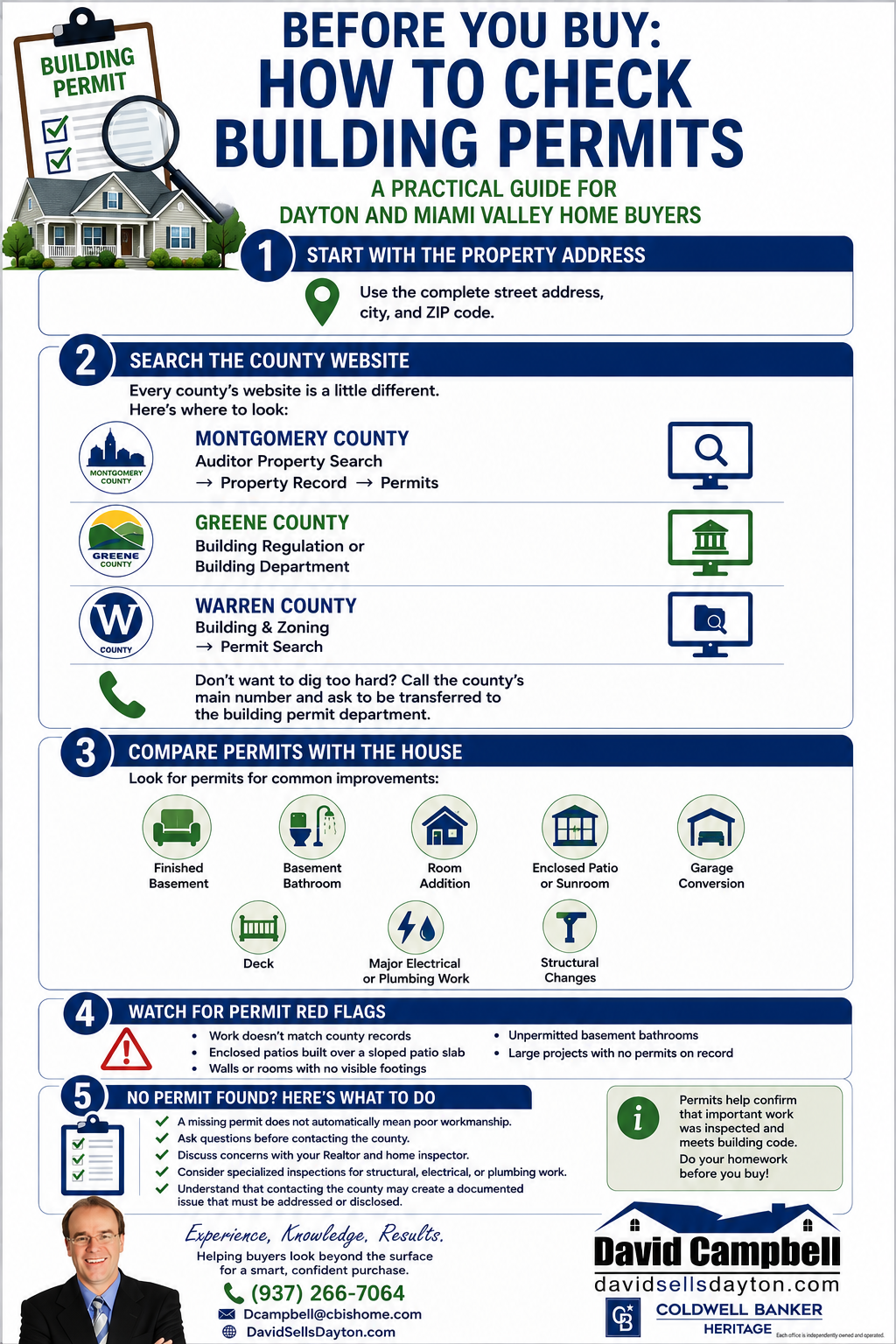
For example, in Montgomery County, I usually start with the Auditor's website. Search for the property by address, open the property record, and look through the menu on the left side. If permit information is available for that property, you'll typically find a section labeled "Permits."
Fortunately, checking building permits is often easier than most buyers think.
In many Ohio counties, permit information is available online. Start by searching for the county where the property is located, then navigate to the appropriate property or building records.
Greene County takes a little more digging. Rather than relying solely on the Auditor's property records, you'll generally need to navigate to the county's Building Regulations or Building Department to research permit information.
In Warren County, you'll typically start with the Building & Zoning Department's permit search rather than the Auditor's property records.
Every county organizes its website a little differently, so don't get discouraged if you don't immediately find what you're looking for.
If you'd rather not spend time searching through county websites, simply call the county's main phone number and ask to be transferred to the department that handles building permits. In my experience, they'll usually point you in the right direction very quickly.
Many Buyers Assume Everything Was Permitted
One of the biggest misconceptions I encounter is that buyers assume every improvement requiring a permit actually received one.
In reality, that's often not the case.
Throughout the Dayton area, it is extremely common to find improvements that technically should have been permitted but were completed without one. That doesn't necessarily mean the work was poorly done, but it does mean buyers should understand what they're purchasing.
One of the most common examples I see is a finished basement.
Many homeowners choose not to notify the county because they're concerned their property taxes will increase once the county learns the basement has been finished.
I'm not suggesting homeowners should skip permits. They absolutely should follow local building requirements. I'm simply sharing what I've observed over three decades in the business.
Personally, I have not seen homeowners experience repercussions simply because a finished basement wasn't permitted. I know there have been situations where Montgomery County or Greene County later reassessed a property after discovering additional finished living space, but I have not personally seen problems arise from that alone.
Smaller projects can be similar.
Some municipalities around Dayton require permits for something as simple as replacing a water heater. Many homeowners don't even realize a permit is required and they make the change without one. I've seen a lot of contractors fail to pull permits when they should have for some of these smaller jobs.
How I Decide When to Check for Permits
I don't automatically investigate permits on every single improvement.
Instead, years of attending hundreds of home inspections have taught me what deserves a closer look.
Certain improvements naturally raise more questions than others.
These include:
- Finished basements
- Room additions
- Enclosed patios
- Garage conversions
- Large decks
- Major electrical or plumbing renovations
- Structural modifications
If something doesn't look original to the home or appears unusually complex, that's when I begin asking more questions.
One Red Flag I Watch For
One of the biggest red flags I notice while showing homes is an enclosed patio.
Many patios originally begin life as simple covered or screened outdoor spaces. Later, a homeowner decides to turn that patio into heated living space by adding framed walls, insulation, windows, and drywall.
The problem is what lies underneath.
A typical patio slab is usually only about four inches thick and is intentionally poured with a slight slope so rainwater drains away from the home.
That slab was designed to support patio furniture—not the weight of fully framed exterior walls and a roof system.
When I see an enclosed patio where the floor still has that noticeable slope, it immediately makes me wonder whether the project was properly engineered and whether permits were obtained.
That's when I start asking questions and looking deeper.
A Real Example from Beavercreek
Although I wasn't personally involved in this transaction, I know of a sale in Beavercreek that demonstrates why permit research can matter.
The home had a bathroom that had been added in the basement.
Before closing, the buyer contacted the county to verify whether permits had been issued for the project.
The county found no permit.
Officials also explained they could not issue a permit after the work was already completed because the plumbing, framing, electrical work, and other construction were hidden behind finished walls. Without being able to inspect the work during construction, they couldn't approve it afterward.
As a result, the seller was left with information that now had to be disclosed to future buyers.
That doesn't automatically make the house a bad purchase, but it certainly created another issue that future buyers would likely ask about.
Unpermitted Work Doesn't Always Mean Poor Work
This is where experience becomes important.
I've seen many homes throughout Beavercreek, Dayton, Fairborn, Centerville, Bellbrook, and surrounding communities that contained finished basements or other improvements completed without permits.
I've also seen many of those homes sell successfully.
The absence of a permit doesn't automatically mean the workmanship is poor.
Likewise, having a permit doesn't automatically guarantee perfect workmanship.
The goal is to understand what you're buying.
If significant improvements were made without permits, buyers should ask questions, evaluate the quality of the work, and determine whether any additional inspections are appropriate.
My Advice to Buyers
If I suspect major improvements may not have been permitted, I investigate before encouraging my buyers to move forward.
In many situations, everything turns out just fine.
Other times, additional information helps my buyers make a more informed decision or negotiate appropriately.
The key isn't to panic over every missing permit.
The key is understanding which projects deserve additional scrutiny and gathering enough information to make an informed decision before closing.
Final Thoughts
Building permits are just one piece of the overall due diligence process when buying a home.
As someone who has spent more than 30 years helping buyers throughout the Dayton area, I've learned that every property has a story. Some homes have permits for every improvement. Others don't.
Rather than making assumptions, ask questions.
Verify major improvements when appropriate.
Lean on experienced professionals, including your Realtor, home inspector, and local building department, to help you understand what you're buying.
A little extra investigation before closing can provide valuable peace of mind and help you avoid surprises after you become the new owner.
Categories
Recent Posts







GET MORE INFORMATION