What Is the Ohio Homestead Exemption? 2026 Eligibility & Income Limits
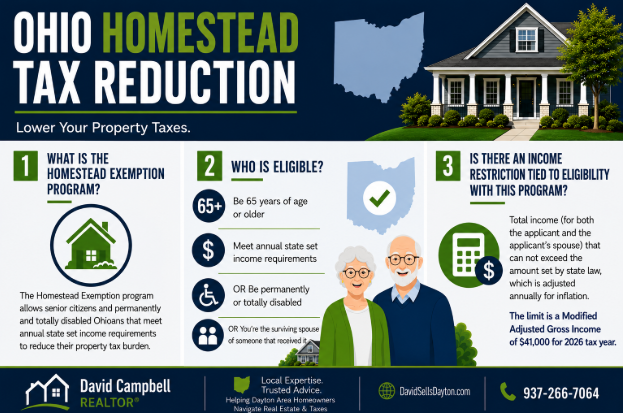
The Ohio Homestead Exemption is a property tax reduction program that allows certain qualifying Ohio homeowners to reduce their property tax burden. There are several ways a homeowner may qualify:
- Be 65 years of age or older and meet the applicable income requirements.
- Be permanently and totally disabled.
- Be the surviving spouse of someone who was receiving the Homestead Exemption, provided the surviving spouse was at least 59 years old when their spouse died and meets the other applicable requirements.
- Be the surviving spouse of a public service officer who was killed in the line of duty.
For the 2026 tax year, the income threshold for the standard income-tested Homestead Exemption is a modified adjusted gross income of $41,000 or less. This amount can change from year to year because Ohio adjusts the income threshold for inflation.
I've been a Realtor in the Dayton area for more than 30 years, and one thing I've learned is that there is quite a bit of confusion surrounding the Ohio Homestead Exemption. Some homeowners don't know the program exists, while others assume that everyone over age 65 automatically qualifies.
That isn't necessarily the case under today's rules.
Isn't the Ohio Homestead Exemption for Everyone Over 65?
This is probably the biggest misunderstanding I encounter.
I regularly talk with homeowners and buyers who believe that once someone reaches age 65, they automatically qualify for the Ohio Homestead Exemption.
There is a reason people may remember it that way.
In 2007, Ohio expanded the Homestead Exemption so that qualifying homeowners age 65 and older could receive the exemption without an income test. Beginning in 2014, Ohio reinstated an income requirement for new applicants.
How Much Can the Ohio Homestead Exemption Save You?
The Homestead Exemption doesn't eliminate property taxes. It exempts a portion of a qualifying homeowner's property value from taxation, which results in a lower property tax bill.
The actual dollar savings varies depending on the property and its taxing district.
In the Dayton-area properties I encounter, I often see the Homestead Exemption reducing the property tax bill by somewhere in the neighborhood of $400 to $700 per year.
That's certainly a worthwhile savings, particularly for a homeowner on a fixed income. But buyers need to understand that the tax bill they're looking at may include a Homestead reduction that they won't receive after purchasing the property.
Why Buyers Should Check for a Homestead Exemption Before Making an Offer
This is where the Homestead Exemption becomes particularly important in a real estate transaction.
Anytime I write an offer on a property, I automatically go to the county auditor's website and look up the property taxes.
One of the things I'm specifically looking for is a Homestead Exemption.
I've found over the years that the Homestead Exemption isn't always accurately identified in the MLS listing. If nobody catches it, a buyer could get fairly far into a transaction believing the seller's current property tax bill is what they should expect to pay after purchasing the home.
Then they discover that the seller qualified for a Homestead reduction and they don't.
Now their future property taxes are going to be higher than expected.
It only takes me a couple of minutes to pull up the property on the county website, scroll through the tax information and determine whether a Homestead Exemption is being applied.
What I Tell My Buyers When a Home Has a Homestead Exemption
If we're looking at a home or preparing an offer and I discover that the current owner receives a Homestead Exemption, I bring it to my buyer's attention.
I don't simply tell them, "The seller has a Homestead Exemption."
I show them the actual dollar amount.
I want the buyer to understand what the current owner is saving and that they may not receive that same reduction after purchasing the property.
More often than not, the buyers I'm working with don't qualify for the exemption. They need to know upfront that their property taxes could be a little higher than what they're seeing on the seller's current tax bill.
I've never had the loss of a Homestead Exemption blow up a real estate transaction.
Part of the reason, in my opinion, is simply addressing it early.
Don't Assume the Seller's Property Taxes Will Be Your Property Taxes
This is an important lesson for anyone buying a home in Beavercreek, Dayton, Centerville, Kettering, Bellbrook, Springboro or elsewhere in the Miami Valley.
The property tax amount associated with a home isn't necessarily what the next owner will pay.
The current owner could have a Homestead Exemption or another tax reduction that won't apply to the buyer. Changes in assessed value can also affect future taxes.
That's why I don't rely solely on the tax amount shown in a real estate listing.
I prefer to go directly to the appropriate county auditor's property records and see what's actually happening with that particular property.
How Do I Know If a Property Has a Homestead Exemption?
For most Dayton-area properties, you can find this information through the county auditor's website.
Look up the property and review the detailed tax information. If a Homestead Exemption is being applied, it should be reflected in the property tax record.
Is the Ohio Homestead Exemption Worth Applying For?
If you qualify, absolutely.
A reduction of several hundred dollars per year may not sound enormous when compared with the value of a home, but property taxes are an ongoing expense. Saving $400, $500, $600 or more every year can become significant over time.
More importantly, if you're eligible for a property tax reduction, there's little reason to voluntarily pay more property taxes than required.
The key is knowing the program exists, understanding the current eligibility requirements and applying if you qualify.
After more than 30 years of helping buyers and sellers throughout the Dayton area, I've found that some of the most useful real estate advice isn't necessarily about negotiating thousands of dollars off a purchase price. Sometimes it's identifying something on a tax record that takes only a few minutes to research but can save a homeowner money year after year.
The Ohio Homestead Exemption is a good example.
Categories
Recent Posts








GET MORE INFORMATION