Do You Have to Sign a Buyer Agency Agreement Before Seeing a Home in Ohio?
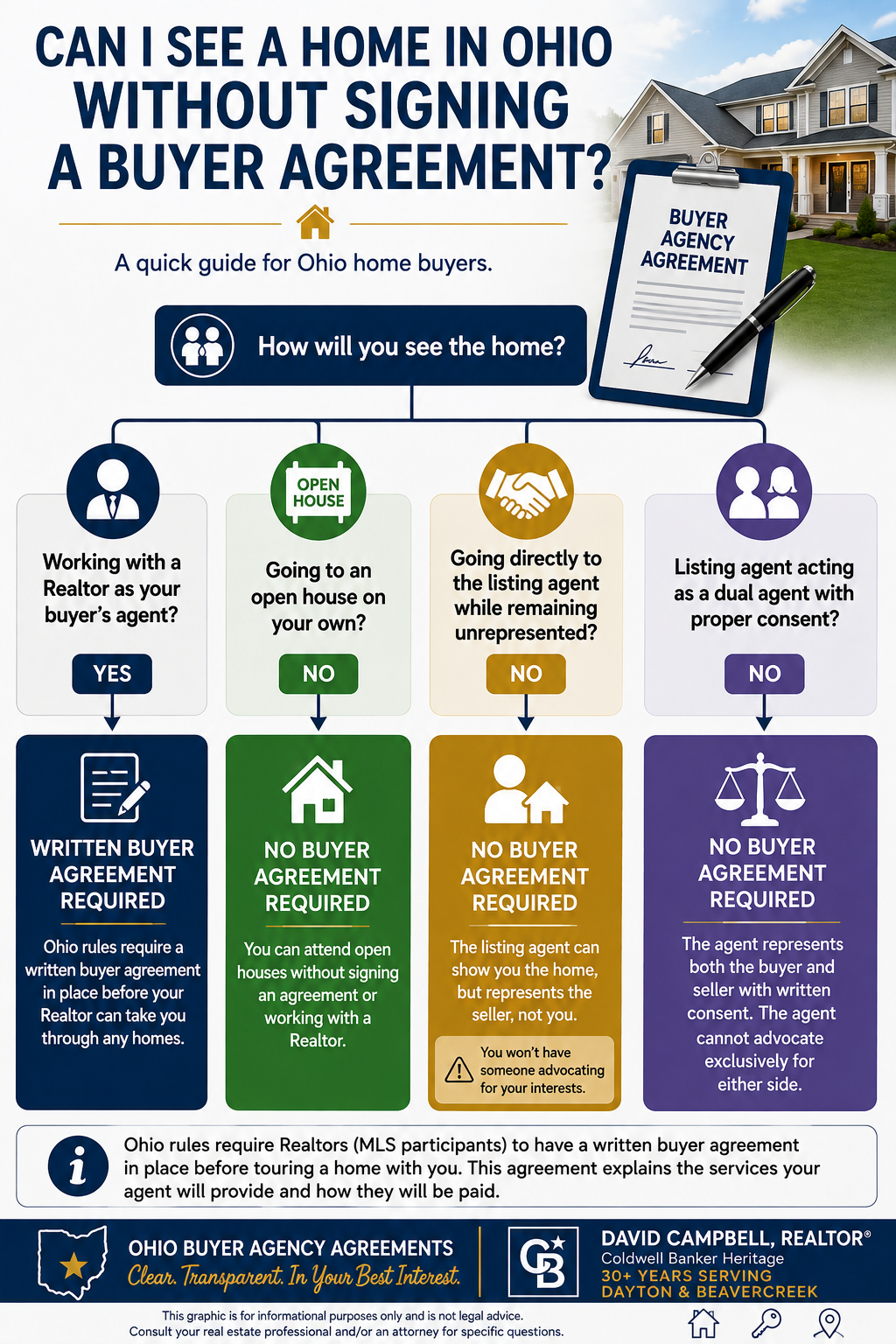
Yes, if you are working with a Realtor you will need to sign a written buyer agreement before that agent takes you through a home. You do not need one simply to attend an open house on your own. Also, an unrepresented buyer can contact the listing agent, who is working on behalf of the seller, and see the home without an agreement in place. The buyer has to understand they are unrepresented and cannot rely on the listing agent for guidance or advocacy. Additionally, the listing agent MAY be willing to be a dual agent, with the sellers permission. The listing agent would then become a 'conduit of information' to assist in putting a deal together - not advocating for either party.
This has been one of the biggest changes to the home-buying process in my more than 30 years of selling real estate in Dayton, Beavercreek and the surrounding Miami Valley.
Why Are Ohio Home Buyers Being Asked to Sign an Agreement?
The change that most buyers are encountering began in August 2024 following the National Association of Realtors settlement. Realtors working with buyers are required to have a written agreement in place before touring a home with that buyer.
The agreement is designed in part to make the relationship between the buyer and their Realtor more transparent, including the services the agent will provide and how the buyer's brokerage will be compensated.
Interestingly, when these changes were first announced, many Realtors—including me—expected considerable resistance from buyers.
That really hasn't happened.
I'm actually surprised by how few buyers question the agreement. We thought buyers might feel trapped by it or that large numbers of buyers would try to bypass buyer agents and go directly to listing agents to avoid a potential buyer-broker fee.
In my experience, that just isn't happening any more than it did before.
Most buyers seem to understand the concept and find it fairly natural to have an agreement establishing who represents them.
Dayton's Military Buyers Were Already Familiar With Buyer Agreements
Dayton is a military town, and because of Wright-Patterson Air Force Base, I work with buyers relocating here from all over the country and sometimes from around t
he world.
I've noticed something interesting with military and relocation buyers.
Some were familiar with buyer representation agreements long before they became commonplace in the Dayton real estate market. These agreements were used much more frequently in some other markets.
I've even had buyers ask about signing a buyer agreement because they had used one when purchasing a previous home.
For many of those buyers, what seemed like a major change to Realtors in Dayton wasn't particularly unusual at all.
Who Pays the Buyer's Realtor?
This is the elephant in the room when I explain a buyer agency agreement.
Buyers want to know:
"Who pays my Realtor, and under what circumstances would I have to pay that fee myself?"
That's an important question.
Before the 2024 changes, it was very common in the Dayton area for the seller's side of the transaction to compensate the brokerage representing the buyer. Buyers often didn't think much about how their agent was being paid.
Today, compensation is much more transparent.
A buyer agreement spells out the compensation arrangement, and broker fees and commissions are negotiable. A buyer can also request that the seller provide compensation toward the buyer's brokerage as part of the transaction.
From a practical standpoint, there are good reasons why sellers still choose to do that.
Most buyers already have substantial cash requirements when purchasing a home:
- Down payment
- Closing costs
- Inspections
- Moving expenses
- Other costs associated with buying and moving into a home
Adding a buyer-broker fee that must be paid directly out of pocket could affect how much house a buyer can afford, what they're willing to offer, or in some circumstances whether they can purchase the property at all.
That's why I believe many sellers recognize the benefit of making their home financially accessible to the largest possible pool of qualified buyers.
Since these changes began in 2024, I have seen little to no reduction in the compensation being paid in my transactions. What has changed considerably is the transparency surrounding how that compensation works.
Do You Have to Sign the Buyer Agreement Immediately?
This is where I handle things a little differently.
I strongly prefer having a buyer consultation before I start showing someone properties. It takes additional time, and not every Realtor does it, but I believe buyers are much better served when they understand the process before they're standing in a house deciding whether to make an offer.
When I introduce the buyer agreement during that meeting, one of the first things I tell them is:
I'm not asking you to sign this today.
It's probably the first time they've seen the document. I want to explain it, answer their questions and make sure they understand what they're agreeing to.
If we decide we're going to work together, then we'll get the appropriate agreement signed before we begin touring properties.
That approach takes much of the pressure out of the conversation.
What If You Sign an Agreement and Don't Like Your Realtor?
This is another concern buyers understandably have.
I've sold real estate for more than 30 years, and for most of my career I successfully represented buyers without requiring them to feel locked into a long-term agreement.
I don't see a reason to change that philosophy now.
My buyer agreement includes language allowing my buyer to cancel the agreement at any time with a phone call to me.
If a buyer believes I'm not providing the service they expected, I've dropped the ball, or they simply aren't comfortable working with me, I don't want an agreement to be the only reason they're staying.
What Happens If You Call Me From Zillow and Want to See a House Today?
Suppose you find a Beavercreek, Centerville, Kettering or Dayton-area home online and call me saying, "I'd like to see this house this afternoon."
My first goal isn't simply to get the door open.
It's to educate you.
I'll explain how buyer representation works and offer to meet with you for a buyer consultation. We'll discuss the buyer agreement, the purchase contract, disclosures and what you should expect throughout the buying process.
That meeting may delay the first showing a little bit, but I believe it makes everything that follows easier.
I have found an educated buyer feels more comfortable with the process, understands what they're signing, knows who represents them and has a much clearer idea of what will happen when we find the right house.
After more than 30 years of helping buyers and sellers in the Dayton area, I still believe that relationship should begin with education and trust—not simply opening a door.
Categories
Recent Posts





GET MORE INFORMATION